
Impact 5.0: A Human Evolution Framework for the AI Era
13/05/2026
Artificial intelligence is transforming the way we work, learn, create, lead and relate to one another. Yet amid this acceleration, one critical question remains largely unanswered:
How do we ensure that technological evolution also leads to human evolution?
Why organizations need a new evolution model
For years, conversations about transformation focused primarily on efficiency, automation and productivity. Organizations invested in digital tools, data systems and innovation strategies believing technology alone would prepare them for the future. But reality is revealing something deeper.
The organizations struggling the most today are not necessarily those lacking technology. They are often the ones lacking clarity of purpose, adaptive cultures, human agency and the capacity to evolve consciously in the middle of uncertainty.
The future will not be defined only by smarter systems. It will be defined by more evolved humans and organizations. And this is the foundation of Impact 5.0.
From digital transformation to human evolution
We are moving from a digital era into an evolutionary era.
Previous transformation models were largely built around modernization: digitizing processes, automating operations and increasing efficiency. Those capabilities remain essential, but they are no longer enough. The AI era demands something more complex: the integration of technology with human development, organizational consciousness and regenerative impact.
Impact 5.0 emerged from that need. Not as another innovation methodology, but as a framework designed to help organizations navigate the next stage of transformation — one where technology and human evolution can no longer be separated. Because organizations are not simply systems of productivity. They are living systems of meaning, relationships, intelligence and action.
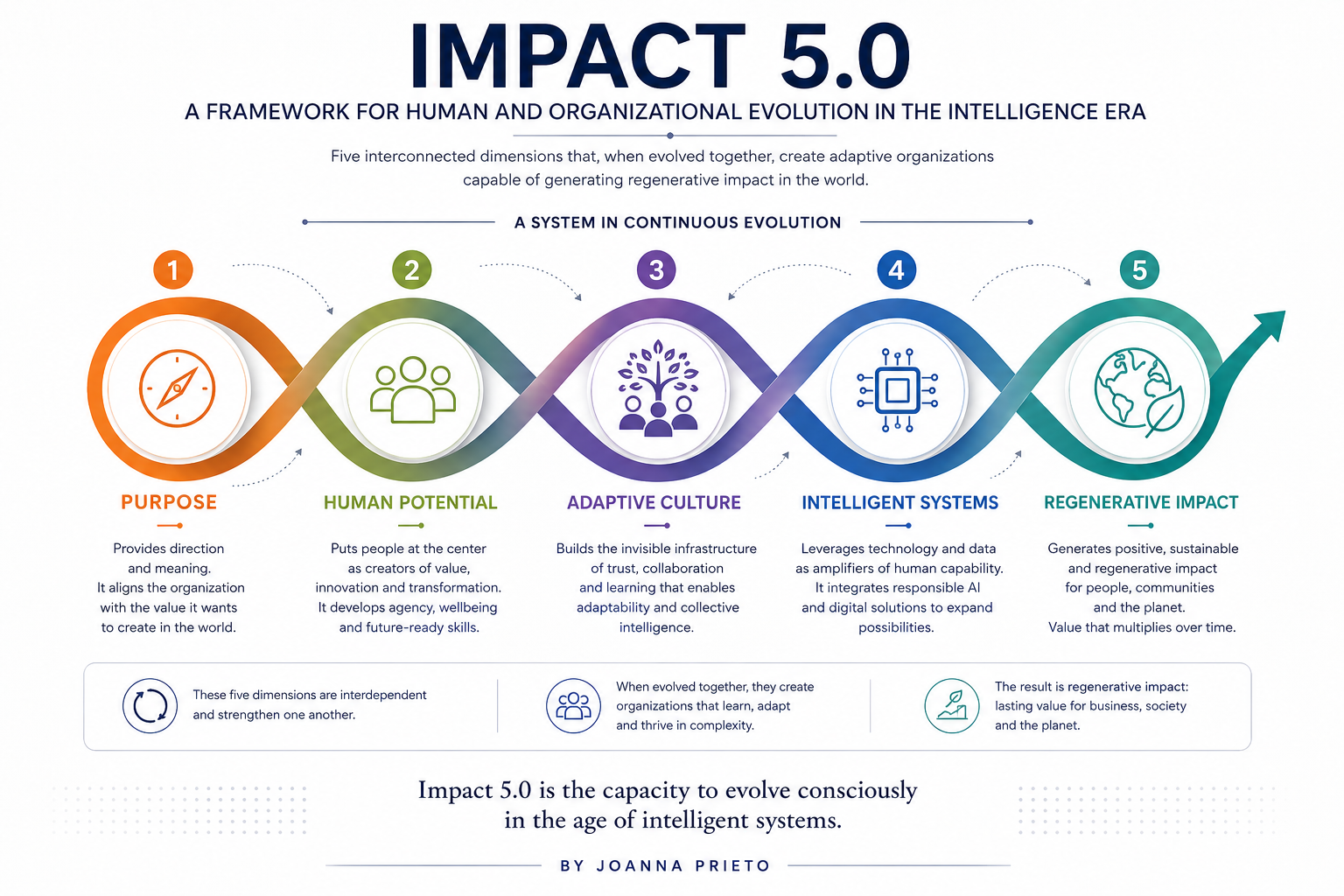
Impact 5.0 Framework — By Joanna Prieto
What is Impact 5.0?
Impact 5.0 is a human-centered framework built around five interconnected dimensions: Purpose, People, Culture, Technology and Impact. The model proposes that sustainable transformation only becomes possible when these dimensions evolve together.
Purpose provides direction. People activate potential. Culture determines the conditions for adaptation. Technology amplifies capacity. Impact ensures that growth creates long-term value for society.
Most organizations tend to overinvest in one dimension while neglecting the others. Some prioritize technology without cultural readiness. Others focus on innovation without human development. Many speak about impact while operating without internal coherence.
Impact 5.0 challenges that fragmentation. It proposes a more integrated vision of transformation — one where business evolution and human flourishing become part of the same conversation.
The five interconnected dimensions of Impact 5.0:
1. Purpose as Strategic Infrastructure
In times of uncertainty, purpose stops being inspirational language and becomes strategic infrastructure. Organizations without a clear sense of purpose often experience fragmentation: disconnected teams, reactive decision-making, innovation without coherence and burnout disguised as ambition.
Purpose creates alignment. It gives meaning to transformation and direction to innovation. More importantly, it helps organizations navigate complexity without losing identity.
In the AI era, where change is constant and information is infinite, clarity of purpose becomes a competitive advantage. The question is no longer only what organizations do. It is what future they are helping create.
2. Human Potential as the Real Competitive Edge
As automation expands, uniquely human capabilities become more valuable, not less.
Technology can optimize processes, but people create meaning, trust, creativity and possibility. The future belongs to organizations capable of developing agency, adaptability, emotional intelligence, systems thinking and continuous learning.
One of the greatest risks of the current technological transition is reducing humans to operational variables instead of recognizing them as drivers of evolution.
Impact 5.0 places human flourishing at the center of transformation, not as a soft aspiration, but as a strategic necessity. Because the organizations that will thrive in the future are not simply the most automated. They will be the most adaptive, conscious and deeply human.
3. Culture: The Invisible Operating System
Many transformation efforts fail not because of strategy, but because of culture. Culture determines how people collaborate, how uncertainty is handled, how decisions are made and whether innovation can genuinely emerge inside an organization.
Yet culture is often treated as secondary compared to technology or growth. Organizations invest heavily in digital transformation while neglecting the emotional and relational architecture required to sustain change.
But transformation cannot scale in environments dominated by fear, fragmentation or rigidity. Adaptive cultures are built intentionally through trust, psychological safety, shared meaning and collective ownership.
In this sense, culture is no longer a side conversation. It is infrastructure for evolution.
4. Technology as an Amplifier
Technology is one of the most powerful amplifiers humanity has ever created. But amplification alone does not guarantee progress.
Technology amplifies systems, intentions, leadership models and cultural patterns. It can accelerate opportunity, but it can also deepen inequality, disconnection and institutional distrust.
The critical question is no longer simply: “What can technology do?” But rather: “What kind of humanity are we amplifying through technology?”
Impact 5.0 proposes a shift from technology-centered transformation toward human-centered technological integration. Technology should expand human capacity, not diminish human agency.
The future is not human versus AI. It is human evolution through conscious integration with AI.
5. From Growth to Regenerative Impact
For decades, success was measured primarily through growth, efficiency and scale. Today, organizations are increasingly being asked a deeper question: What kind of impact are we generating in society?
Impact 5.0 expands the definition of value creation. It recognizes that organizations shape communities, mental health, education, opportunity, trust and the future social fabric itself.
Regenerative impact means creating conditions where people, organizations and ecosystems can evolve and thrive together. This requires moving beyond extractive models toward systems capable of generating long-term human and social value.
In this emerging era, impact is no longer peripheral to business strategy. It is becoming one of its most important measures of relevance.
We are entering a period where technological acceleration is outpacing human adaptation. This is creating anxiety, polarization, institutional distrust and leadership crises across sectors. The challenge of our time is not only technological disruption. It is human readiness.
The organizations that will lead the future are not necessarily the fastest adopters of technology. They will be the ones most capable of learning, adapting, collaborating and generating meaningful impact in rapidly changing environments.
Impact 5.0 offers a framework for that transition. Not toward a more automated future alone, but toward a more conscious, adaptive and human future.
We often speak about innovation as if it were mainly about invention. But the deeper challenge is evolution. The future requires more than smarter tools. It requires wiser leadership, stronger agency, regenerative systems and organizations capable of aligning technology with human flourishing.
Perhaps the most important question of the AI era is not: “How advanced can technology become?” But: How do we evolve enough as humans to use it wisely? That is the invitation of Impact 5.0.
Joanna Prieto speaks internationally about human-centered innovation, collective intelligence, AI culture, and regenerative leadership for the AI era. Contact her here
AI and humanitycollective intelligencefuture of workhuman development in the AI erahuman-centered innovationImpact 5.0Joanna Prietoorganizational evolutionpurpose-driven innovationregenerative leadership